At Salt & Pepper, we spend our days designing the future of connected products. But lately, we’ve noticed a disconnect. While the hype around the Internet of Things (IoT) is bigger than ever (smart home devices amount to a $44 billion market in Europe this year alone), the conversations we have with actual users are often filled with hesitation, frustration, and anxiety.
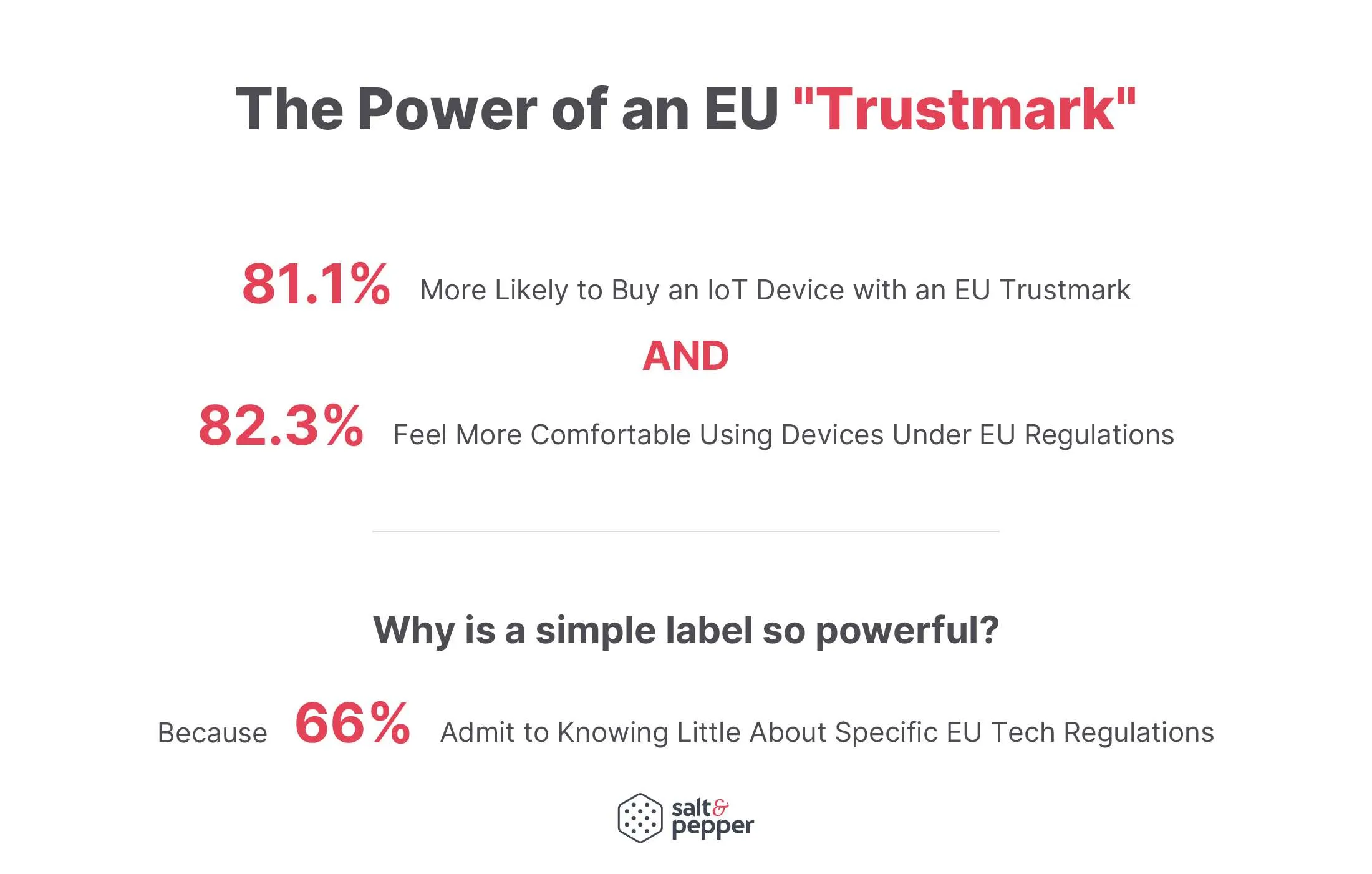
To put hard numbers to this feeling, we launched a comprehensive survey of 1,200 consumers across four key European markets: the U.K., Denmark, The Netherlands, and Germany. Our findings confirm a massive “Trust Deficit” is holding the industry back, representing the single greatest threat to the future potential of the smart home. The report reveals a clear solution demanded by consumers themselves: an overwhelming 81.1% are more likely to buy an IoT device if it has an official EU certification for security.
The data also reveals this isn’t one single problem; it’s a complex issue, with deep fractures appearing along national, gender, and generational lines.
The big picture shows a market defined by distrust
The promise of consumer IoT is one of seamless convenience, but the reality for many is an experience riddled with anxiety and frustration. Our data shows that these are not minor issues, but foundational problems that actively suppress sales and undermine long-term user satisfaction with their IoT devices.
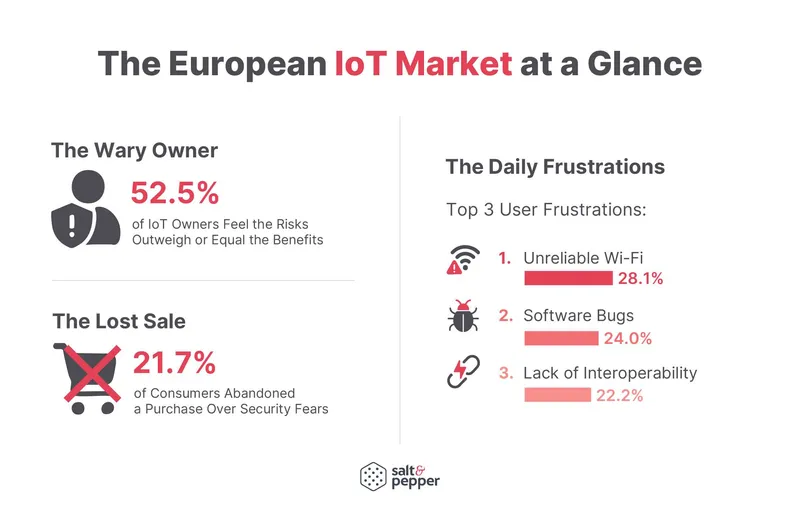
- Risks Outweigh Rewards For more than half (52.5%) of current smart device owners, the perceived security and privacy risks are equal to or greater than the benefits they receive. This indicates a fragile relationship with technology that many users tolerate rather than embrace.
- A Tangible Barrier to Sales This fear has a direct financial impact. Over one in five consumers (21.7%) have been stopped from purchasing a specific IoT device they were considering due to security concerns, representing a significant loss of market potential.
- A Frustrating User Experience Beyond trust, the industry is failing to deliver on the core promise of simplicity. The top three frustrations are universal: unreliable Wi-Fi (28.1%), software bugs (24.0%), and devices from different brands not working together (22.2%).
An overwhelming demand for EU regulation
While the trust deficit is a huge problem, the data points to a surprisingly clear solution that consumers are actively asking for. They are looking to regulators to provide a simple guarantee of safety in a complex market.
The headline finding is stark: an overwhelming 81.1% of European consumers would be more inclined to purchase an IoT device if it featured an official certification or “trustmark” showing it meets high EU cybersecurity standards.
This isn’t because they are legal experts; in fact, 66% of consumers admit they know very little or nothing about specific regulations like GDPR or the AI Act. This is precisely why they need a simple label: it serves as a trusted shortcut to peace of mind, doing the complex work of verification for them. This positions EU regulation not as a business hurdle, but as a powerful, consumer-demanded feature.
How trust and technology differ across markets
While often treated as a single entity, the European market is a mosaic of distinct consumer cultures. Our survey highlights that a “one-size-fits-all” approach to product design and marketing is destined to fail, as factors like cultural attitudes toward privacy and market maturity create profoundly different expectations.
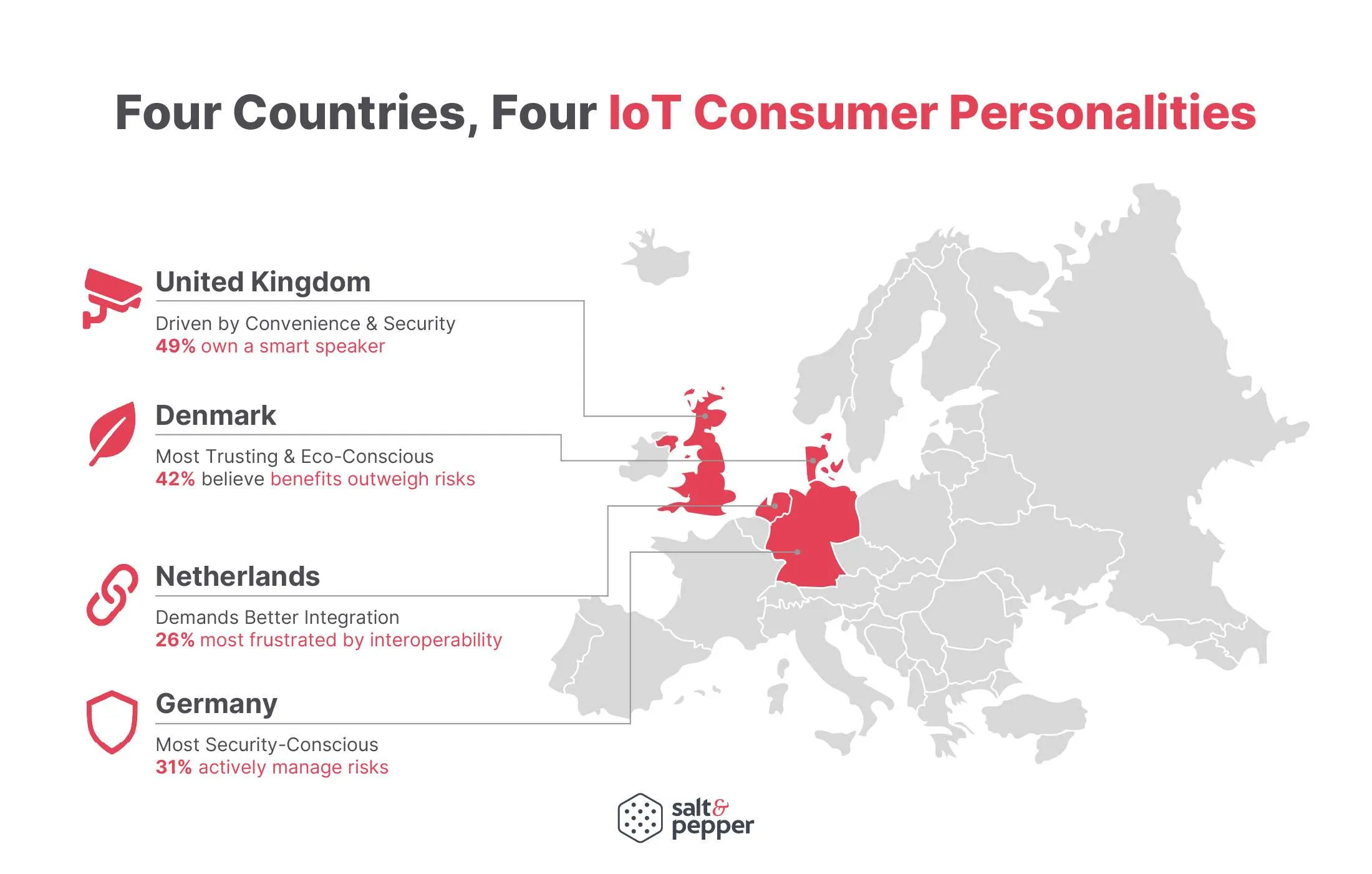
- Germany: The Epicenter of Skepticism Out of the four markets we surveyed, German consumers are the most skeptical, representing the ultimate challenge in building trust in IoT devices. They are the most likely to abandon a purchase over security fears (26%) and the most proactive in managing their digital security (31%).
- United Kingdom: Focus on Convenience & Security The U.K. market is driven by a desire for security and ease. Consumers here lead in the adoption of security cameras (26%) and smart speakers (49%), but are the least likely to be motivated by energy efficiency (11%).
- The Netherlands: The Advanced but Frustrated User Dutch consumers are among Europe’s most advanced IoT users, leading in integrated systems like smart lighting (31%). This ambition, however, leads to a unique frustration: they are the most annoyed by different brands not working together (26%).
- Denmark: The Pragmatic & Trusting Model In a continent of doubt, the Danes are the most optimistic of the bunch. They are the most likely to believe that the benefits of IoT outweigh the risks (42%), and are the most motivated by tangible goals like saving energy (19%).
The smart home’s gender usability gap
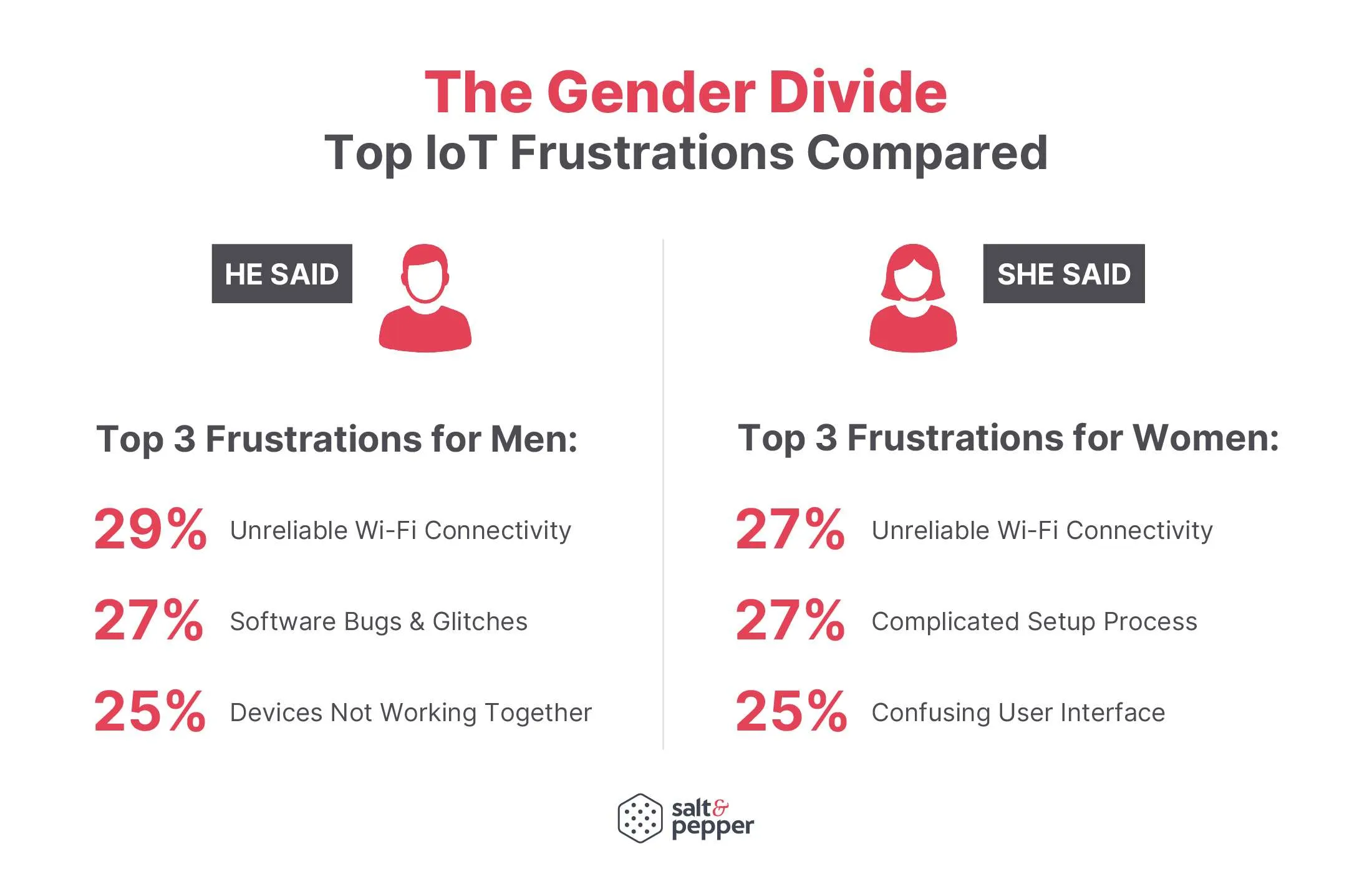
The complexity often deepens within the home itself, where the data reveals that men and women often experience their IoT devices through entirely different lenses. These findings suggest that an IoT industry that defaults to a male-centric, “gadget-focused” design approach may be failing to meet the core needs of many female users.
- Performance vs. Usability Men are more likely to be frustrated by technical performance issues, with 27% citing “software bugs” as a top issue, compared to 21% of women. Women, in contrast, are more frustrated by usability, such as a “complicated setup process” (25% of women vs. 19% of men).
- Differing Privacy Concerns The divide extends to privacy, where women express a significantly higher concern about “devices listening or recording without consent” (45% vs. 35% of men), a fear tied directly to personal space.
Butler vs. spy: the generational clash over AI
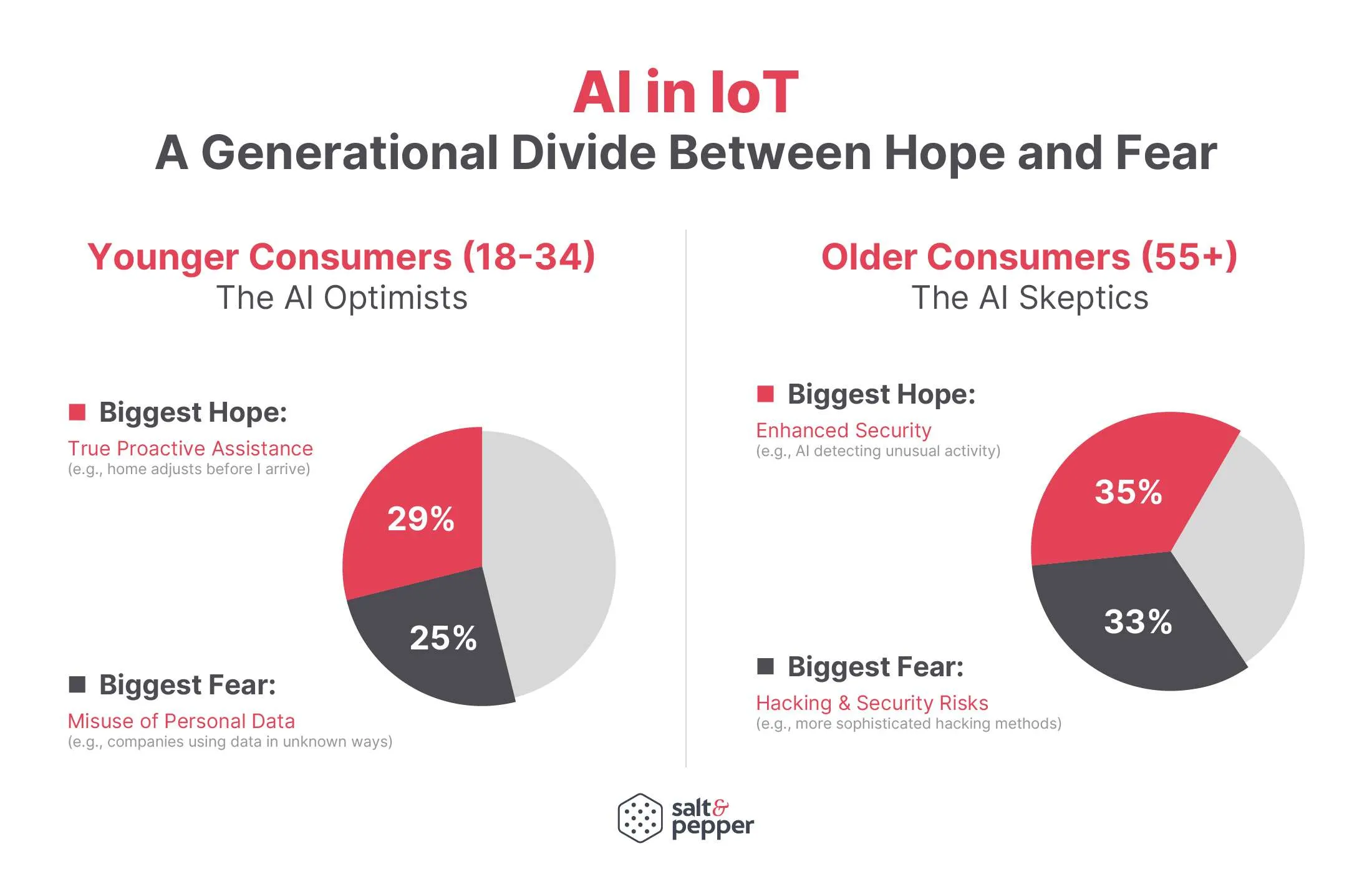
Artificial Intelligence is poised to be the next major driver of IoT innovation, but our data reveals a deep chasm in perception between the generations who will use it. This presents a fundamental design challenge: how to build AI that feels empowering to one group without feeling intrusive to another.
- The ‘AI Butler’ Younger consumers (18-34) are AI optimists. They are nearly twice as likely as the 55+ cohort to name “true proactive assistance” as their top hope for the technology. They are ready for an AI that seamlessly manages their lives.
- The ‘Digital Spy’ Older consumers (55+) are AI skeptics. Their biggest fears are “security risks” (33%) and a “loss of control” (25%). For this group, an AI that makes decisions on its own feels more like a threat than a convenience.
The path to trust: navigating a fragmented market
The message from 1,200 European consumers is clear: the future of the IoT market hinges on building trust. Yet, as the data shows, “trust” is not a monolithic concept. It means robust security for a German consumer, intuitive usability for a female user, and safeguards against AI overreach for an older generation.
For innovators and product leaders, navigating this fragmented landscape is the defining challenge of the next decade. Success is no longer just about the technology; it’s about deeply understanding the diverse human needs behind it. Our full report provides the data and strategic framework needed to meet this challenge.
For a deeper dive into all 27 survey questions, conclusions, insights from IoT industry experts and players, and strategic principles for building trust in a fragmented market, download the complete “IoT Trust Deficit” report.
Methodology
The findings in this article are based on a quantitative online survey of 1,200 adult consumers (aged 18+) across the United Kingdom, Germany, the Netherlands, and Denmark, conducted in June 2025. The final data was weighted to accurately reflect the adult population of each country.